

Identity platform architecture
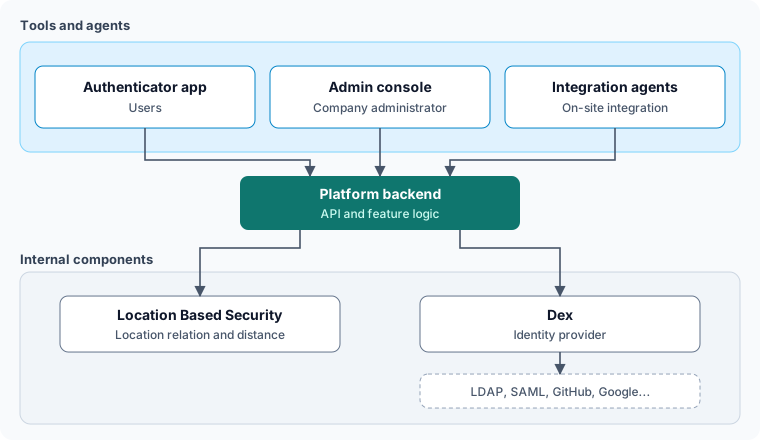
The Ironchip identity platform is made up of tools for users and administrators, integration agents and internal components.
User tools
Section titled “User tools”These architectural components are designed for two kinds of users:
- Company administrator: the IT technician in charge of managing the policies, users and services connected with location-based authentication.
- User: the people who authenticate with the Ironchip identity platform.
Authenticator app
Section titled “Authenticator app”Mobile application that users of the platform use to authorize access to the integrated services, in accordance with the established access policy.
It has two modes of operation: one with location and one without it, using only the device.
The authenticator app is designed to be secure, with additional safety measures on top of Location Based Security. It provides biometric mechanisms to unlock local storage when available, making it virtually impossible for an external attacker to clone the device.
It is also easy to use and has a friendly interface. The authenticator is a public application for any user of your company’s services, and its user experience is designed so that all kinds of users can authenticate with it.
If you contact support, you can also get a corporate application with a custom design, color palette, logo and name.
Admin console
Section titled “Admin console”Company management application to manage the users, integrated services, access policies and integration methods of the platform.
The Ironchip identity platform uses standard protocols to integrate external services. They let Ironchip integrate with popular services such as Microsoft Active Directory, Microsoft 365, webmail or Adobe products.
The console gives you fine-grained control over your organization’s access policies: which users can access which services, and in which safe zones that access is possible. This lets any IT administrator keep full control and accountability over the accesses happening in real time.
Ironchip provides support for questions about the console, plus several resources to learn all of its features: a full walkthrough of the platform, tutorials for specific actions and user documentation.
Integration agents
Section titled “Integration agents”These agents are the components needed for on-site integration between the identity platform and some services that depend on specific protocols.
Internal architectural components
Section titled “Internal architectural components”These components are internal and transparent to you.
Location Based Security
Section titled “Location Based Security”Location Based Security is the business core of Ironchip. This component hosts the artificial intelligence responsible for detecting which locations are related and the distance between them.
Location Based Security is a product by itself that lets a company integrate custom workflows with Ironchip’s security AI. To learn more about its possibilities, contact your sales representative.
Location Based Security is used not only for authentication: it also has many applications in fraud detection. Because of these critical uses, it is designed to be resilient, responsive and fast. These requirements translate into better security and performance for the identity platform.
Ironchip’s core combines classical deterministic physics-based algorithms with state-of-the-art AI technologies, which makes the algorithm stable, safe, trustworthy and adaptable to new circumstances.
Location-based authentication backend
Section titled “Location-based authentication backend”The identity platform backend exposes the API that implements all the feature logic and the communication with the services it depends on, namely Location Based Security and Dex.
Because the backend is the pillar of a security product, security is one of the main criteria in development decisions. The backend is built around security features such as active monitoring, exclusion of private data from the databases, and encrypted, salted and peppered token and password hashes.
Because the business model covers both large and small companies, the backend is designed to scale. It is deployed in a dynamic environment that assigns and releases capacity based on the current use of the platform.
Finally, the backend is stable: it is built on battle-tested technologies, techniques and methodologies, and depends only on highly available services.
Dex identity provider
Section titled “Dex identity provider”Ironchip uses Dex. Dex acts as a portal to other identity providers through connectors. This lets Dex defer authentication to LDAP servers, SAML providers, or established identity providers such as GitHub, Google and Active Directory. Clients write their authentication logic once to talk to Dex, and Dex handles the protocols for a given backend.
Dex is an open source project listed in the Cloud Native Computing Foundation (CNCF), which makes it a stable and well-backed project. It has a constantly growing community of developers and is very active.
Was this page helpful?
Thank you. We will use it to improve the documentation. If you want to tell us what is missing or unclear, write to support@ironchip.com.