

iOS SDK
The iOS SDK collects device and environment signals on every sensitive operation and sends them to the Ironchip fraud engine. Use it if your mobile app is a native iOS app.
Requirements
Section titled “Requirements”| Platform | Supported versions |
|---|---|
| iOS | 13.0.0+ |
Installation
Section titled “Installation”Add the package with Xcode
Section titled “Add the package with Xcode”-
In Xcode, go to the root of your application (for example,
ExampleApp.xcodeproj), select theExampleAppitem under PROJECT, and open the third tab, Package Dependencies. -
Click the + button.
-
In the pop-up window, paste the repository URL into the search field and click Add Package: https://github.com/Ironchip-Security/LBFraud-SDK-iOS.git
-
Under Dependency Rule, choose an exact version, a range of versions, or a branch. Choose the exact version
1.2.10(the latest release), or the Up to Next Major Version rule starting at1.2.10, which makes package upgrades easier.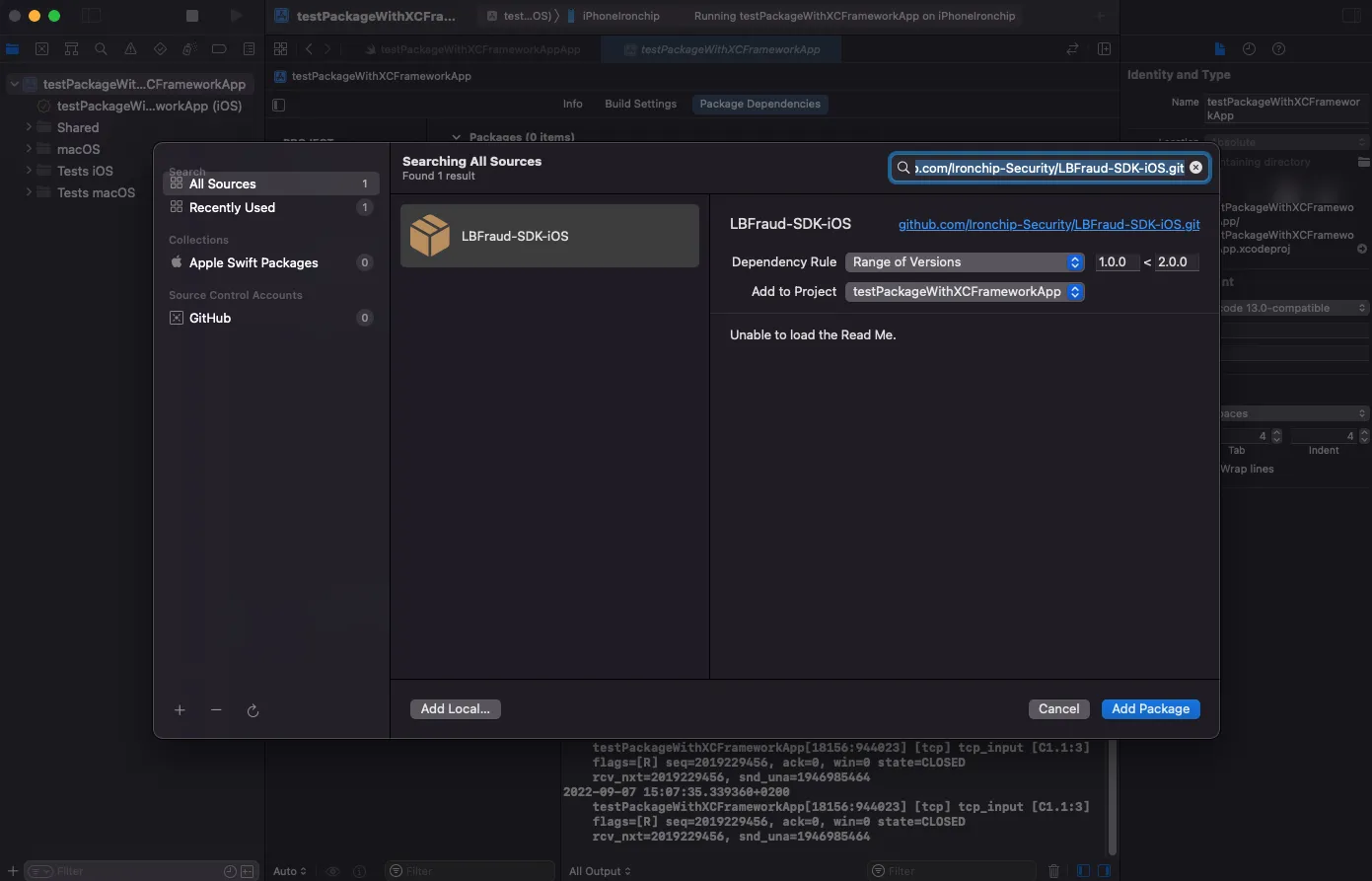
Add the Wi-Fi capability
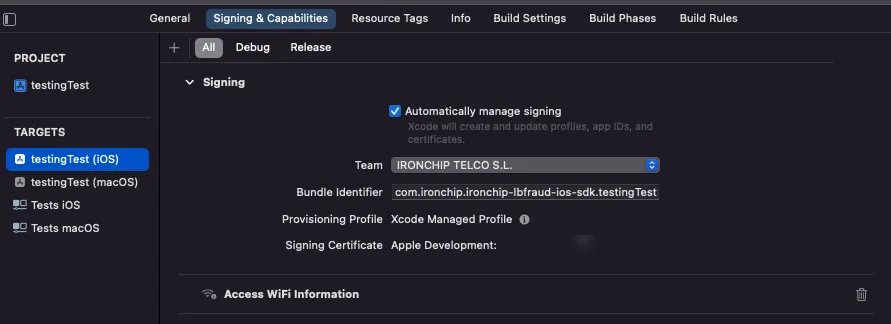
Section titled “Add the Wi-Fi capability”To use Ironchip LBFraud as a Swift Package, add a capability to your app target: go to Signing & Capabilities and add Access WiFi Information.
Add the location permissions
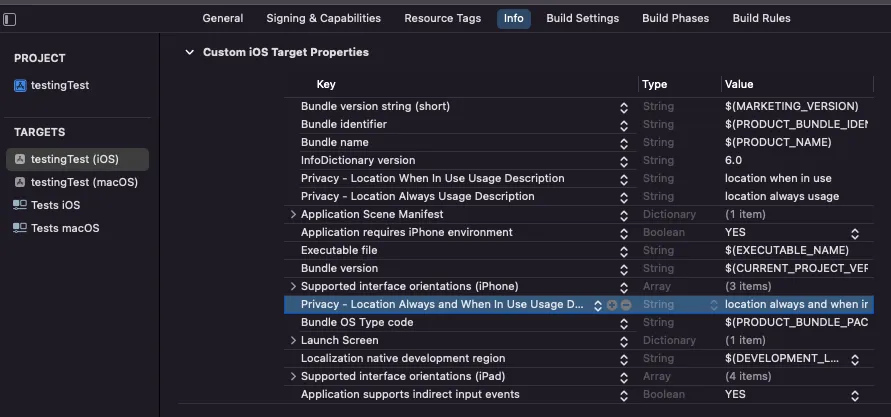
Section titled “Add the location permissions”In the app target, open the Info tab and add the following keys. For each one, enter the description as a string:
Privacy - Location Always and When In Use Usage DescriptionPrivacy - Location When In Use Usage DescriptionPrivacy - Location Always Usage DescriptionLSApplicationQueriesSchemes: this permission lets the SDK detect whether the device is jailbroken.
Request the location permission
Section titled “Request the location permission”Before using the SDK, your app must request the location permission:
import CoreLocation
let locationManager = CLLocationManager()locationManager.requestWhenInUseAuthorization()
Use in an app
Section titled “Use in an app”Call the library initialization method on the main thread.
import LBFraudSDKiOS...
// Replace apikey with the API key generated in the console.let ironchipLBFraud = LBFraudSDK.init(apikey: "XXXXXX.XXXXXXXXXXXXXXXXXXXXXXXXXXXXXXXXXXXXXXXX")// The SDK sends transactions to the Ironchip production environment.
// Send a transaction to the Ironchip fraud engine for analysislet extraData: [String: Any] = [    "concept": "Book august",    "amount": 60,    "operation": "booking"]
// transactionId (required, unique): identifier you will later use to request the report// userId (required): user identifier// extraData (optional): extra information for analysis
// sendTransaction accepts two callbacks: the first runs when the transaction has finished// and the second runs if an error occurs during the process.
ironchipLBFraud.sendTransaction(transactionId: "random_identifier_generated", userId: "john.doe@gmail.com", extraData: extraData, finish: {    // Code to run when the transaction has finished.    }, onError: { err in
    // Code to run if an error occurs during the transaction.
    // Example:        //if(err is TransactionError) {
            // let transactionError = err as! TransactionError
            // print(transactionError.traceability_id)            // print(transactionError.message)            // print(transactionError.http_code)            // print(transactionError.code)        //} else {            // print("NetworkError: ", err)        //}    })
Example
Section titled “Example”Full example: after a successful login, the user identifier is anonymized with SHA-256 and the transaction is sent.
import LBFraudSDKiOSimport Foundationimport CommonCrypto
// Replace apikey with the API key generated in the console.let ironchipLBFraud = LBFraudSDK.init(apikey: "XXXXXX.XXXXXXXXXXXXXXXXXXXXXXXXXXXXXXXXXXXXXXXX")
// Log in and send the transaction if the login succeedsfunc login(username: String, password: String) {    Task {        let loginSuccessful = await performLogin(username: username, password: password)
        if loginSuccessful {            // If the login succeeds, call sendTransaction with the required parameters            let transactionID = generateRandomTransactionID(length: 10) // Generate a unique transaction ID            let anonymizedUserID = anonymizeUserID(username) // Anonymized user ID
            let extraData: [String: Any] = [                "amount": 30, // Use an appropriate amount                "operation": "login" // Specify the operation            ]
            await sendTransactionAfterLogin(transactionID: transactionID, anonymizedUserID: anonymizedUserID, extraData: extraData)        } else {            // Handle the login failure        }    }}
// Simulated asynchronous loginfunc performLogin(username: String, password: String) async -> Bool {    try? await Task.sleep(nanoseconds: 2 * 1_000_000_000)
    return true}
// Send the transaction after a successful loginfunc sendTransactionAfterLogin(transactionID: String, anonymizedUserID: String, extraData: [String: Any]) async {    ironchipLBFraud.sendTransaction(transactionId: transactionID, userId: anonymizedUserID, extraData: extraData, finish: {        // Code to run when the transaction has finished.    }, onError: { err in        // Code to run if an error occurs during the transaction.    })}
// Generate a transaction IDfunc generateRandomTransactionID(length: Int) -> String {    let characters = "abcdefghijklmnopqrstuvwxyzABCDEFGHIJKLMNOPQRSTUVWXYZ0123456789"    var randomID = ""    for _ in 0..<length {        if let randomCharacter = characters.randomElement() {            randomID.append(randomCharacter)        }    }    return randomID}
// Trim, lowercase, and hash the userIdfunc anonymizeUserID(_ userId: String) -> String {    let trimmedLowercaseUserID = userId.trimmingCharacters(in: .whitespacesAndNewlines).lowercased()    return sha256Hash(trimmedLowercaseUserID)}
// Compute the hash with SHA-256func sha256Hash(_ input: String) -> String {    let inputData = Data(input.utf8)    var hash = [UInt8](repeating: 0, count: Int(CC_SHA256_DIGEST_LENGTH))    inputData.withUnsafeBytes {        _ = CC_SHA256($0.baseAddress, CC_LONG(inputData.count), &hash)    }
    return hash.map { String(format: "%02x", $0) }.joined()}
Changelog
Section titled “Changelog”1.2.10 (2023-10-11)
Section titled “1.2.10 (2023-10-11)”Added
- Communication detection.
- SIM network type (2G, 3G, 4G, 5G).
1.2.9 (2023-05-18)
Section titled “1.2.9 (2023-05-18)”Added
- SDK version added to the transaction model.
1.2.8 (2023-05-12)
Section titled “1.2.8 (2023-05-12)”Removed
- Transaction model updated to remove information about the device’s SIM and eSIM cards.
1.2.7 (2023-03-23)
Section titled “1.2.7 (2023-03-23)”Added
- Commons is now linked from LBFraud instead of being embedded.
1.2.6 (2023-03-15)
Section titled “1.2.6 (2023-03-15)”Added
- Transaction model updated to include information about the device’s SIM and eSIM cards.
1.2.5 (2023-02-02)
Section titled “1.2.5 (2023-02-02)”Changed
- Transaction model updated to include the status of the requested permissions.
- Transaction model updated to include whether the GPS and Wi-Fi providers are enabled.
1.2.4 (2022-12-20)
Section titled “1.2.4 (2022-12-20)”Changed
- Fixed the problem when validating the app in the App Store.
- Location service logs for iOS 13.
1.2.3 (2022-12-09)
Section titled “1.2.3 (2022-12-09)”Changed
- Fixed an issue with the fingerprint ID.
- Handling of external HTTP calls.
1.2.2 (2022-11-30)
Section titled “1.2.2 (2022-11-30)”Changed
- Changed some device properties in the transaction model.
1.2.1 (2022-11-22)
Section titled “1.2.1 (2022-11-22)”Changed
- Class name refactoring.
- Log tags updated to match the refactoring.
- The Fraud constructor no longer accepts a URL host; it only allows selecting the desired environment.
- The GPS service throws an error when the permission is not granted or the location service is disabled.
1.2.0 (2022-10-31)
Section titled “1.2.0 (2022-10-31)”Added
- Debug logs.
Changed
- Changes in the transaction model.
- Management of new errors in the Commons library.
Removed
- Custom network errors: generic errors are now thrown instead.
1.1.8 (2022-10-25)
Section titled “1.1.8 (2022-10-25)”Changed
- Version 1.1.7 was promoted to 1.1.8 for organizational reasons.
1.1.7 (2022-10-25)
Section titled “1.1.7 (2022-10-25)”Added
- Support for iOS 13 and later.
Changed
- The package URL moved to GitHub.
1.1.6 (2022-09-14)
Section titled “1.1.6 (2022-09-14)”Removed
- Unnecessary
printstatements.
1.1.5 (2022-09-14)
Section titled “1.1.5 (2022-09-14)”Added
- The Commons library throws custom errors, and LBFraud rethrows them.
Changed
- Commons services renamed.
1.1.4 (2022-09-12)
Section titled “1.1.4 (2022-09-12)”Added
CHANGELOGfile added to the project.
Changed
- Model parameter names and structure changed.
1.1.2 (2022-09-03)
Section titled “1.1.2 (2022-09-03)”Changed
- Changed the repository name of the
.xcframework.zip.
1.1.1 (2022-08-27)
Section titled “1.1.1 (2022-08-27)”Added
- The project now has two
.xcframeworkfiles: one for the Commons library and one for LBFraud.
Changed
- The Swift Package now gets the
.xcframeworkfrom a remote location instead of a local one.
1.1.0 (2022-08-24)
Section titled “1.1.0 (2022-08-24)”Added
LICENSEfile added to the project.
1.0.9 (2022-08-23)
Section titled “1.0.9 (2022-08-23)”Added
- First stable version of a Swift Package with one XCFramework called
LBFraudSDKiOS.xcframework.
Was this page helpful?
Thank you. We will use it to improve the documentation. If you want to tell us what is missing or unclear, write to support@ironchip.com.